All the Old Buzz
Headlines & Mentions

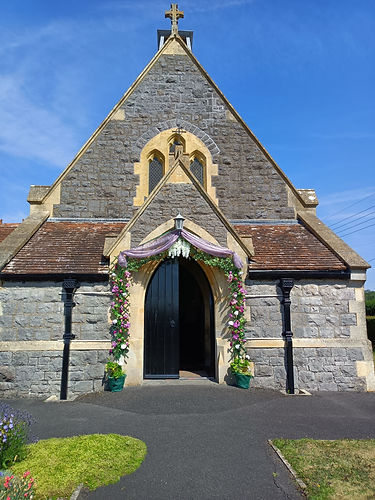
Outdoor services
Excellent Wedding Venues
History
Here is some of the collected history for both Holy Trinity and St Barnabas as well as our sister parish in Yatton.
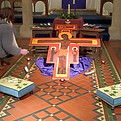
Holy Trinity
A short history of the Church at Cleeve, Compiled by L.I. Roberts in 1973 and updated by R. Ford in 1999 and T. Dyer in 2000. It can be seen here.
In the early 19th Century Cleeve, together with Kenn was part of the Parish of Yatton. When Kenn became a separate parish, the Rev. Richard Symes, who had become Curate of Yatton in 1829 devoted a lot of time to the Village of Cleeve, and commenced to hold services in the school room, which had once been a barn.
In the late 1830's it was decided to build a Church at Cleeve, According to an early history there is a legend that, "the owner of. Brockley Hall a Pigott or a Smyth-Pigott, fell out with the Vicar of Brockley, a relative, and so that he could show his independence he built a Church at Cleeve, to which he attached nearby,
The Architect was G.P. Manners Esq. of Bath, who was also the Architect of many Churches in these parts. Holy Trinity Church is one of the few Churches built in Somerset in the 19th century that was built in the Romanesque style. The Church was built with stone from the local quarry.
In the late 1920's the present pews in the nave were installed to replace the chairs which had been used since the restoration, I do not know if they were the original chairs, these pews were a gift of Mr. Meade-King, Vicar's Warden at the time. All the wood, American Oak, was planed by hand. The remaining pews in the Chancel and transept were given by Mr. Millier (1934) and Mr. Evans (1937).
On Tuesday the 18th June 1940 the Centenary Celebrations of the Consecration of the Church were held. Many former Ministers and other people connected with the Church were invited, and attended. A social gathering, which had been planned for the afternoon, was cancelled because it was war time.
The car park was added in 1997 at about the same time as an amplified sound system. The car park was officially opened by the archdeacon, the Rev'd Robert Evens. The cost of land purchase and construction was £14,000 which was all raised by public appeal and donations. This was all achieved in a matter of months. The planning and construction was overseen by Mr. Roger Ford and the landscaping was provided by Mr. Michael Pitman.
In 2005 and again in 2007 the Rev. Cathy Horder led the way towards Holy Trinity being awarded the Eco Church award which is proudly displayed next to the side entrance to the building and in 2021 our final stipendiary priest, Rev Nigel Thomas encouraged us to achieve Bronze award in the new A Rocha Eco Church award scheme.
St Barnabas
The History of St Barnabas by Brian Wills
St Barnabas Church has been the centre of the Lower Claverham Community for over 125 years.
Records show that the original building and many of the internals have, over the years been provided by the members of the local village community.
With the Church approaching its 130" anniversary, the local community are once again working together to secure funds to build an adjoining meeting room.
This history has been compiled with the help of the residents in Claverham as one of many fund raising efforts.
A licence for worship was first granted on August 14° 1879 and the first service took place on September 17" 1879.
There was a weekly Sunday service at 3.30pm, which was occasionally a communion service.
Funding for the original building was provided by The Diocesan Board who gave £40 from the church buildings
and education funds, while St Mary's congregation provided nearly £5 from its harvest collection. — Ecclesiastical
Commissioners and the Incorporated Society for Promoting the Enlargement, Building and Repairing of Churches and
Chapels also provided funds.
The church was furnished with 48 rush chairs from Henley-‘on Thames costing £7 6s, 48, Ancient and Modern hymnbooks from London, kneelers, lamps and a crimson-royal cloth.
By 1911 the church was referred to as St Barnabas.
From 1874 the Vicar of Yatton, Prebandary Henry Barnard was
instrumental in setting up the mission church at Jasmine Lane, Claverham.
Originally called the Mission Room and Busy Bee, St Barnabas was built in 1879 on land donated by John Cox and family as a daughter church of St Mary's, Yatton. John Cox was a local landowner and tanner.
There were three ‘public houses in the remoter parts of Claverham which are said to have caused rowdy behaviour and non attendance at St. Mary's, Yatton of some Claverham residents.
Prior to the building of the church, services were held in a barn and then a disused billiard room.
Built by John Clark a mason from Blagdon assisted by local carpenter William Gregory, architects were Hans Price and
Wooler of Weston-super-Mare.
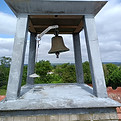
The church had a small steeple, which was demolished in 1956 for safety reasons and replaced by a bell tower.
The original building cost £454 13s 10d but the builder had to pay £11 11s 3d in fines on account of non-completion.
The church was listed in 1986.
The mobile baptismal font, lectern and book shelves were made by Cyril Day a church treasurer in 1963.
The pulpit was given in memory of Charles Crocker who died in 1942 and the wooden altar rail in memory of John
Cleverdon who died in 1946.Both were local farmers.
Directly behind the Church is the former Rectory. Built in 1962, the house became a private home in the early 1970's.
In 1920 the Church Room, a wooden building possibly used by the army mule trainers at Avonmouth in the First World
War, was set up as a Church Room in memory of those who died in the First World War. The Church Room was
demolished in 1987, as it did not fulfil regulations.
Those listed on the 1914-1918-war memorial died mostly in France except for three who died at Gallipoli, Salonica and in East Africa. All were in their twenties or thirties. A list of our war heroes is included at the end of this history.
Privacy

1. Your personal data – what is it?
Personal data relates to a living individual who can be identified from that data. Identification
can be by the information alone or in conjunction with any other information in the data
controller’s possession or likely to come into such possession. The processing of personal data
is governed by the General Data Protection Regulation.
The data we collect includes:
• Contact details including your name, address, phone number and email address.
• Photographs taken during events
• Specific information required to manage financial giving schemes and Gift Aid
We may collect additional information required for pastoral services such as baptisms,
weddings, funerals and services of remembrance.
There may be occasions we collect specific information, for example, food intolerances for
catering events.
2. Who are we?
The PCC of Holy Trinity and St Barnabas is the data controller. This means it decides how your
personal data is processed and for what purposes.
3. How do we process your personal data?
The PCC complies with its obligations under the “GDPR” by keeping personal data up to date;
by storing and destroying it securely; by not collecting or retaining excessive amounts of data;
by protecting personal data from loss, misuse, unauthorised access and disclosure and by
ensuring that appropriate technical measures are in place to protect personal data.
We use your personal data for the following purposes: -
• To administer membership records;
• To fundraise and promote the interests of the charity;
• To manage our employees and volunteers;
• To maintain our own accounts and records
• To inform you of news, events, activities and services running at Holy Trinity and St
Barnabas, and the Cleeve with Claverham and Yatton Moor Group Ministry;and in the
communities we serve.
• To share your contact details with the Diocesan office so they can keep you informed
about news in the diocese and events, activities and services that will be occurring in
the diocese and maintain records.
4. What is the legal basis for processing your personal data?
• Explicit consent of the data subject so that we can keep you informed about news, events,
activities and services and keep you informed about diocesan events.
• Processing is necessary for carrying out legal obligations in relation to Gift Aid or under
employment, social security or social protection law, or a collective agreement;
Page 2 of 2
Privacy Notice v1- May 2026
• Processing is carried out by a not-for-profit body with a political, philosophical, religious or
trade union aim provided: -
o the processing relates only to members or former members (or those who have
regular contact with it in connection with those purposes); and
o there is no disclosure to a third party without consent.
5. Sharing your personal data
Your personal data will be treated as strictly confidential and will only be shared with other
members of the church to carry out a service to other church members or for purposes
connected with the church. We will only share your data with third parties outside of the parish
with your consent.
6. How long do we keep your personal data?We keep data in accordance with the guidance set out in the Church of England recordsretention Guides. Specifically, we retain electoral roll data while it is still current; gift aiddeclarations and associated paperwork for up to 6 years after the calendar year to which theyrelate; and parish registers (baptisms, marriages, funerals) permanently.7. Your rights and your personal dataUnless subject to an exemption under the GDPR, you have the following rights with respect toyour personal data: -• The right to request a copy of your personal data which the PCC holds about you;• The right to request that the PCC corrects any personal data if it is found to beinaccurate or out of date;• The right to request your personal data is erased where it is no longer necessary for thePCC to retain such data;• The right to withdraw your consent to the processing at any time• The right to request that the data controller provide the data subject with his/herpersonal data and where possible, to transmit that data directly to another datacontroller, where applicable.• The right, where there is a dispute in relation to the accuracy or processing of yourpersonal data, to request a restriction is placed on further processing;• The right to object to the processing of personal data, where applicable.• The right to lodge a complaint with the Information Commissioners Office.8. Further processingIf we wish to use your personal data for a new purpose, not covered by this Data ProtectionNotice, then we will provide you with a new notice explaining this new use prior tocommencing the processing and setting out the relevant purposes and processing conditions.Where and whenever necessary, we will seek your prior consent to the new processing.9. Contact DetailsTo exercise all relevant rights, queries or complaints please in the first instance contact thePCC c/o 1 Millier Road, Cleeve, Bristol. BS49 4NL Tel: 01934 904765You can contact the Information Commissioners Office on 0303 123 1113 orCommissioner's Office, Wycliffe House, Water Lane, Wilmslow, Cheshire. SK9 5AF
Disclaimer
This disclaimer states that the information contained in herein is for informational purposes only and should not be interpreted as legal advice.
We do not assume any responsibility for any omissions or errors in the information provided.
Cleeve with Claverham PCC is not responsible for any claims, costs, or damages that arise from the use of this website content.
Cleeve with Claverham PCC is not responsible for any warranties, expressed or implied, regarding the use of this website content.
It should be noted that the information contained in this website may also be used for other purposes without our consent.
Note well that Cleeve with Claverham PCC is based un the UK and that UK laws will be used to settle any disputes that arise from the use of this website content.
Should any part of this disclaimer is found to be unenforceable, the remaining parts of the disclaimer shall remain in effect.
